Just a quick note to let those of you who graciously stop by to see if I have posted anything new know that I am still alive. Alive and busy. I am obviously not doing anymore "Find a new home for it Fridays" - time just does not allow, though it was fun to try. Don't anyone get your feelings hurt, but I am going to delete those posts in order to clean up my blog some, getting back into focus why I started this blog and then staying focused, Lord willing. I also do not plan to add more on Chores For Little People at this time. Seems like when I was in the midst or writing about this topic MANY other great bloggers were doing the same! I would direct anyone with more questions to Managers of Their Chores at Titus2. It is great! I haven't read the WHOLE book yet, but what I have read is very helpful and gives lots of ideas for chores for all age groups. Don't expect anything too soon, but I have started writing up a post that will explain better what I have been doing and thinking lately in regards to being a "keeper" of my home and the use of my time and better uses of my time. Hope you'll hang in there and keep checking back to see what I have to share.
Summertime Blessings, jerri
June 19, 2006
Time and No Time

April 20, 2006
Chores for Little People: Part Two - Chores Little People Can Do
I thought I would share our current chore chart so you can see some of the different chores my little people do. Our chore chart gets changed a few times a year. Seasonally outdoor work is added or taken away, as an example. I have a seperate chart for kitchen chores and laundry days.
Starting at the top, by name, the ages of the children are: 17,14,11,9,8,6,6 and 4. You will need to click on the picture of the chore chart to see it larger.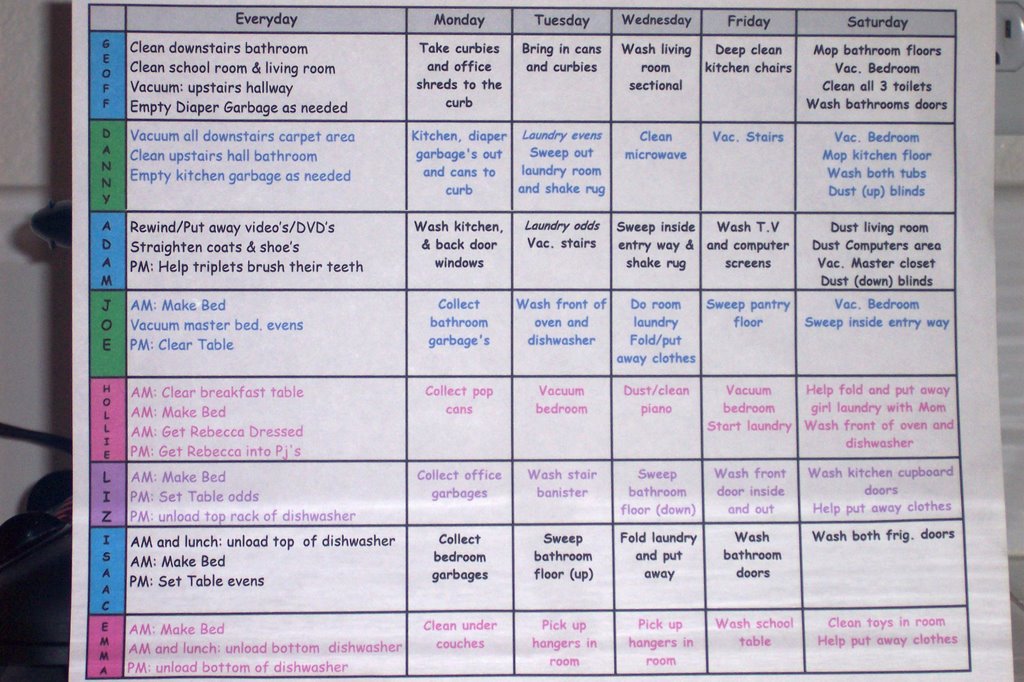 One of the most important things I do, besides teaching the child how to do a chore, is set them up for success. What do I mean by this? For instance, with unloading the dishwasher I have the youngest child unload the bottom rack because it is lowest to the ground and generally doesn't have highly breakable items in it. I also store all my dishes in lower cupboards so that the children can easily reach them. I use Corelle plates for daily dishes, since they do not break very easily. When I do have a special item that is breakable or goes in a cupboard out of the child's reach, they know to put that item on the counter and I will put it away for them. A lot of people are surprised to find my plates and bowls in lower cupboards, but when I explain the reason for it they totally agree it is a great idea! I have set my kitchen up with little people in mind. Kitchen towels, bibs and wash cloths are also in the lowest drawers in the kitchen so my little laundry helper can put them away when she helps me with folding.
You can use my kitchen example in every room of the house. Toys in the bedroom should be stored where the child can put them away. Clothing should go in drawers the child can reach. Books where the child can put them away. If a child can't reach a sink or washing machine, be sure to have a step stool they can use. Cleaning supplies for little people (we use a rag and water for the under 8 children) need to be where they can reach them. A dust pan with a matching small hand broom is great for little hands to sweep out small places.
Continuing with my dishwasher example, once a younger child has graduated from the lower rack (graduation comes with age, skill and a younger sibling ready to take on the bottom rack), the child moves up to the top rack of the dishwasher. We do keep our cups, mugs and glassware in an upper cupboard. So, this child needs to be steady on a chair so they can stand on it to put away the cups, etc. Usually the sharp knives are in the upper rack also and so the child must be taught to put those away carefully.
One last thing I will share in this post is what we call being a "padawan". This is a Star Wars Jedi term that we have found suits the time in a child's life when he works side by side with an older, experienced sibling, learning a new, more difficult chore. We have used it at different times with different children. At first the "master/teacher" does the chore in front of the padawan (younger child) every time it is done, progressing to having the padawan help with the chore and eventually the padawan does the whole chore while the master/teacher sibling watches. Once the older sibling lets me know his/her padawan is competent, I rearrange the chore chart and the padawan is now on their own with this new chore. This has worked great for having the older children teach the younger ones how to clean the bathroom, set the table, do dishes, etc.
I also team up younger children on tough jobs, like kitchen chores. Right now my 8 and 9 year old work together two mornings a week to do the breakfast kitchen. We do kitchen clean up and wash dishes at every meal (big family, remember?). Setting and clearing of the table are done separately from the person who has "kitchen" chore. Kitchen chore includes: loading dishwasher and washing by hand anything that does not fit in the dishwasher, washing sink and counters, stove top, table, chairs and sweeping the kitchen and dining rooms. Three times a day.
For part Three I am going to give more ideas of chores my little people have done, as well as pictures of my little people actually doing chores, for all you visual learners. =)
April 8, 2006
Chores for Little People : Part One - Getting Ready
Why Teach Little People To Do Chores?
In my first laundry post I wrote a little about using the time in a child's life when they greatly desire to help and find helping to be fun as the perfect time to be training them in doing chores. You will never find another time in the child’s life when they will be so happy to learn and do chores as when they are 18 months—4/5 years old. It does take some thought and planning at first. It will take more of your time, mothers. You will be learning patience, dads. You will have to sacrifice a little in the “now” in order to reap the harvest in the future.
Our children are an investment. We invest blood, sweat and tears into their growth and development, hopeful to produce an adult not only ready to join society, but one that will be a blessing to all around him/her and seeks to serve the Lord and the world around him/her. As parents we need to always be future minded in our parenting. Just as we might make an investment that will bring dividends years in the future, so it is with training little ones while they are young.
Chores are a medium for teaching our children a lot more than how to wash dishes or fold laundry. These are important life skills everyone should at least know how to do, even if they don’t need to do them on a regular basis as adults. It would be very short sighted if we thought of chores only as a way to keep the house clean. Children learn work ethics, working together, working for a common goal and working to provide.
2 Thessalonians 3:10 “For even when we were with you, we would give you this command: If anyone is not willing to work, let him not eat.”
Other benefits include learning to get along with others, working for the common good of the family and fostering the child's place in society and the family. They have a place. They have purpose. They have goals.
An excellent article in the recent edition of “No Greater Joy” magazine demonstrates how all these facets of training, chores and discipline all come together. Here is the focal part of the article:
“There is nothing worse on a child’s self esteem than to be treated as one not yet ready to join the human race. When you don’t give children a focus, they focus on themselves—a most unhappy condition. When Gracie is rebuked or sp*nked for not obeying, she sometimes gets upset—emotionally wrought. At that point her parents find it difficult to communicate with her. She is no doubt thinking how mistreated she is, how deprived. She wanted her way—some forbidden pleasure—and “the big guys” are again constraining her to a behavior she would never choose for herself. There is a danger at this point that the child will succumb to a willful desire to defy. But Shalom handles it with wisdom. When she sees that Gracie is upset for having her will thwarted and is wrestling with the unpleasantness of losing the confrontation, rather than to dwell on the unpleasantness and demand that Gracie get her attitude right, Shalom turns to her and unemotionally commands, “Gracie, take these clothes to the laundry,” or “Gracie, pick up your toys.” Shalom said that Gracie is so well conditioned to participation in the everyday family chores, that she will unthinkingly turn to obey any command. In so doing, she forgets about herself and steps back into the fellowship of life. Her mother’s goal is to restore Gracie to a walk of compliance, and as quickly as possible. Rather than allowing Grace to slump into her disappointment, she is led to step through a less emotional door, back into the path of cooperation and obedience. Any single true act of obedience translates into an obedient child.”
What better way to get a child's thoughts off himself/herself than to immerse them back into the routine of work and family fellowship?
When I was first thinking about writing about chores for little people I came across a news article titled “Study Shows Babies Try To Help”. This study showed that as young as 18 months old little ones desire to help. Here is an excerpt :
“ Any parent can relate tales of a wobbly toddler's endearing desire to help out. Now scientists have documented it, in a study suggesting that the capacity for altruism emerges as early as 18 months of age.
It was a simple experiment to illustrate fairly sophisticated brain development: Tots watched as psychology researcher Felix Warneken did ordinary tasks, such as using clothespins to hang some towels.
Oops, he dropped a clothespin. Video shows one overall-clad baby glancing between Warneken's face and the dropped pin before quickly crawling over, grabbing the object, pushing up to his feet and eagerly handing back the pin.
Warneken never asked for the help and didn't even say "thank you," so as not to taint the research by training youngsters to expect praise if they helped. After all, altruism means helping with no expectation of anything in return.
Over and over, whether Warneken dropped clothespins or knocked over a stack of books or lost a marker he was going to write with, each of 24 toddlers repeatedly helped within seconds …”
You see, even scientist can document what most mothers have knows for centuries; starting at a very young age, children DO like to help. How you choose to use this ability is up to you.
Next: Part Two - Getting Started / Chores Little People Can Do

March 8, 2006
Laundry - Part Three

There has been quite a few good questions,( SOCKS!!), come up in the COMMENTS sections at the end of each of the Laundry posts. Be sure to look at the comments section for more laundry information. (Also, thanks to all who have put in suggestions for future topics!)
Couple of things about Laundry that I didn't explain fully:
1. When the little girls are doing their laundry I am with them the whole time helping to keep them on track and I also fold the 2 y.o.'s clothes.
2. Dish cloths, bibs and rags get taken to the washer as soon as they are dirty (this is usually several times a day). Whoever uses the washer next just includes them with their load and brings them to the kitchen after they are done drying.
For those of you who are despairing of ever catching up on your laundry I recommend two things:
1. Set up a new laundry routine that you think will work for your family. Use some of the ideas I have shared and try them out. Put it in writing. Try it for a month and then re-evaluate and fine tune it to suit your needs.
2. Set aside one day, the whole day, and work on the laundry until it is all caught up. Yes, even if you homeschool you can do this! This is your Home Economics class for the week/month/year. Set aside all the usual school subjects. Use this day to teach the children how to sort clothes, load the washer, set the washer settings, add the detergent/fabric softener, clean out the dryer lint catcher, start the dryer, fold clothes and put them all away. You might be thinking to yourself that there will be too much time while loads are running with nothing to do. Ha! Get out all those unmatched socks and have a game of "match the socks". The person who comes up with the most matches wins! If you still have excess time, have the kids go through their drawers and see if there are more unmatched socks hiding and also have them reorganize their drawers. Really ambitious? Have the kids go UNDER THEIR BEDS and pull out everything: toys, books, rubberbands, school books (so THAT is where that book went!), SOCKS, pencils, and don't forget the dust bunnies. You should also use this time to TEACH the children the NEW laundry routine/schedule. Fill the day with fun and prizes! Be creative! Give prizes for best attitude, fastest worker, tidiest drawers, best folder, etc. Don't forget that your GOOD attitude will go a long way in teaching the children that doing laundry and your new routine will be a benefit to the whole family.
March 2, 2006
Laundry - Part Two
 Laundry day begins.
I take the dirty laundry bags and empty hangers from my bedroom downstairs. I only wash the laundry from my room (hubby, baby and I).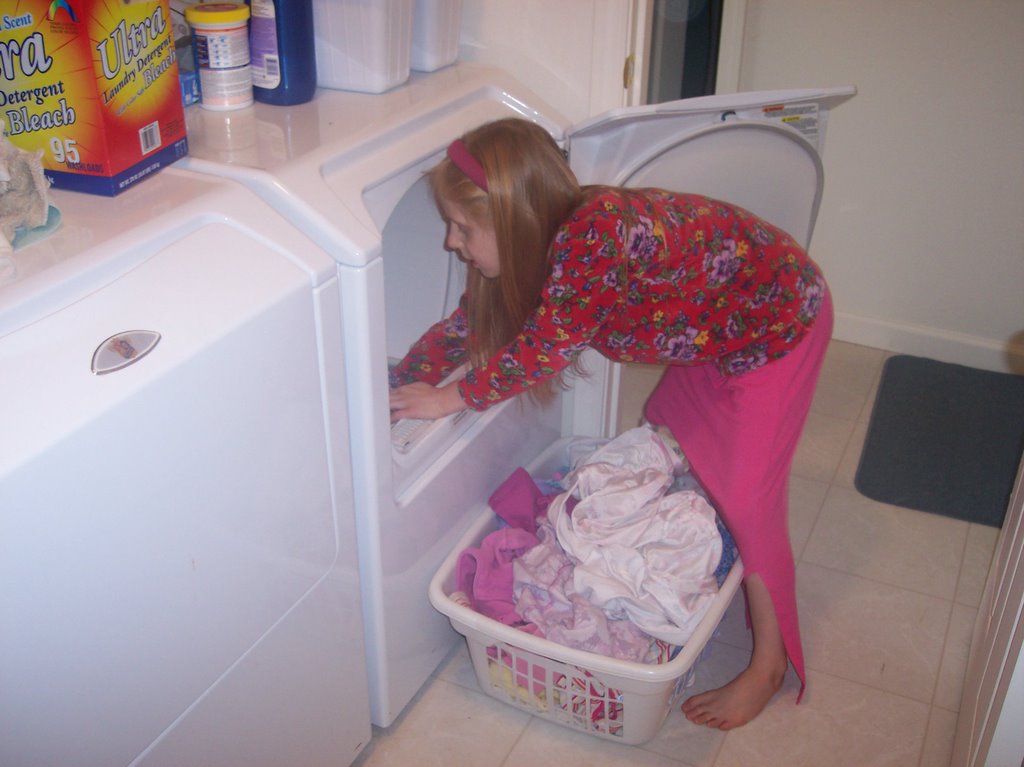 8 y.o. daughter gets her rooms (she shares a room with her three younger sisters) first load out of the dryer. She had one load in the washer and one in the dryer by the time she went to bed the night before. As her loads shift from washer to dryer and dryer to basket, I can start my two loads.
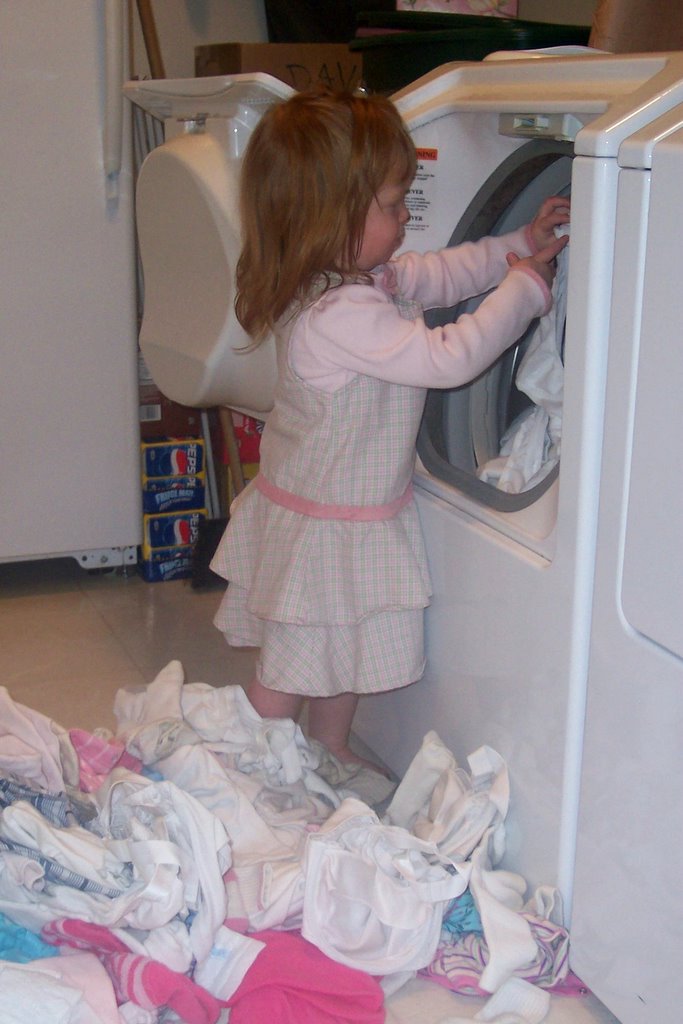 2 y.o. daughter loves to help mommy do the wash! Here she is putting the whites into the washer. With my help she adds the detergent and pushes the start button too!
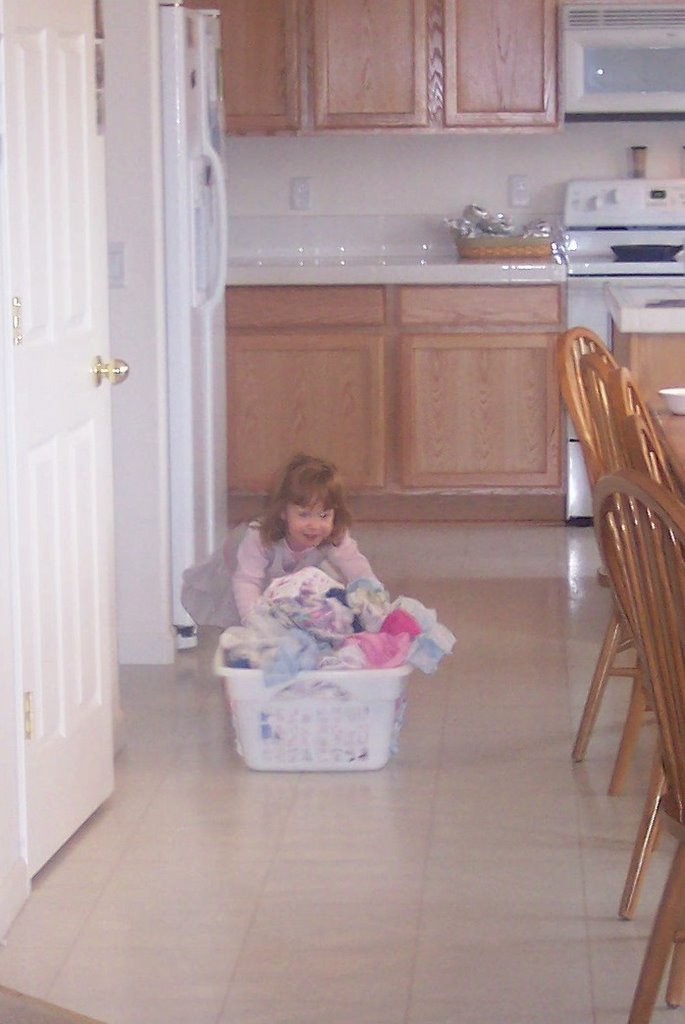 When the girls laundry (second load here) is done drying, 2 y.o. loves to put it into the basket and then push it to the folding area (the family room).
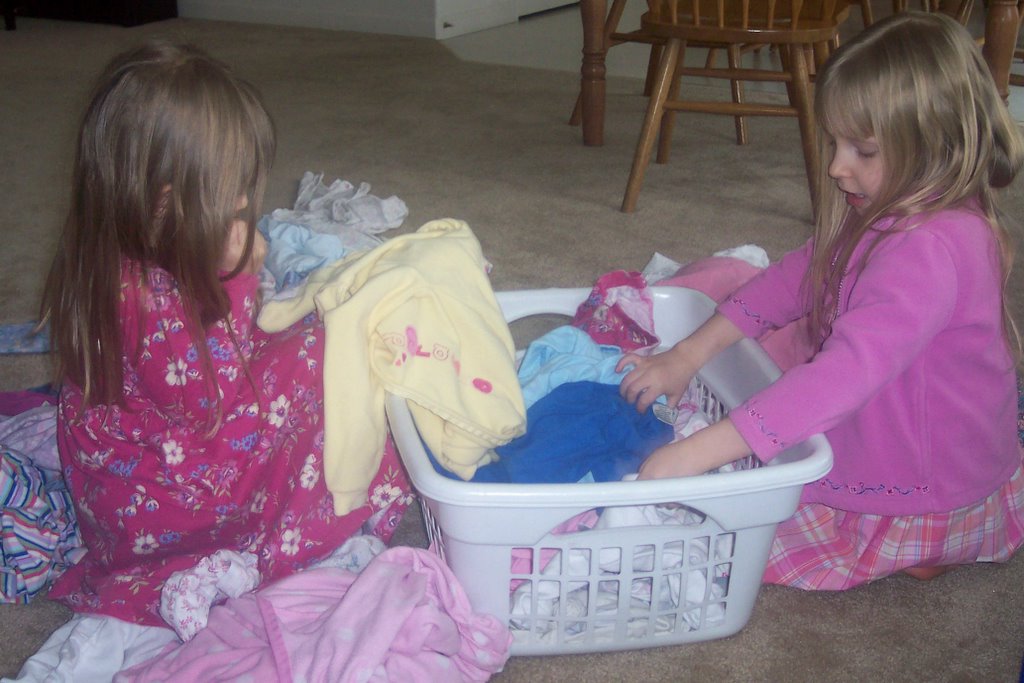 With the girls two loads washed and dried it is time to sort the clothes. 5 y.o. and 4 y.o. daughters make a pile of clothes for each of the 4 girls.
 Each of the girls puts their dresses on hangers, folds their clothes and puts them in piles to be taken upstairs when they are all done. Here is the 4 y.o. putting a dress on a hanger.
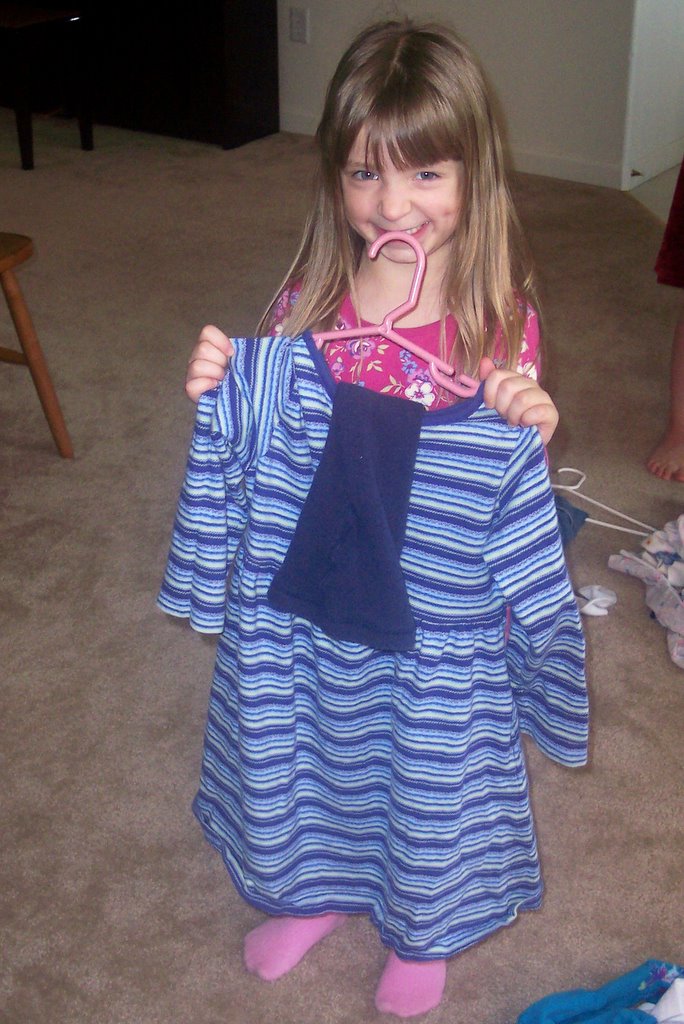 During the cold months my girls wear tights with their dresses a lot. The best way I have found to help them store their tights is to match up the tights with a dress and put them with the dress on the hanger. This also takes the guess work out of finding the right tights for each dress in the mornings.
During the warmer months the tights get put away and socks (or mostly bare feet as they like to wear sandles) are worn more. When the girls are all done folding and hanging this is how it looks: a pile of dresses on hangers for each girl and below her dresses are her pile of folded clothes (underpants, socks, pj's, shorts, etc.)
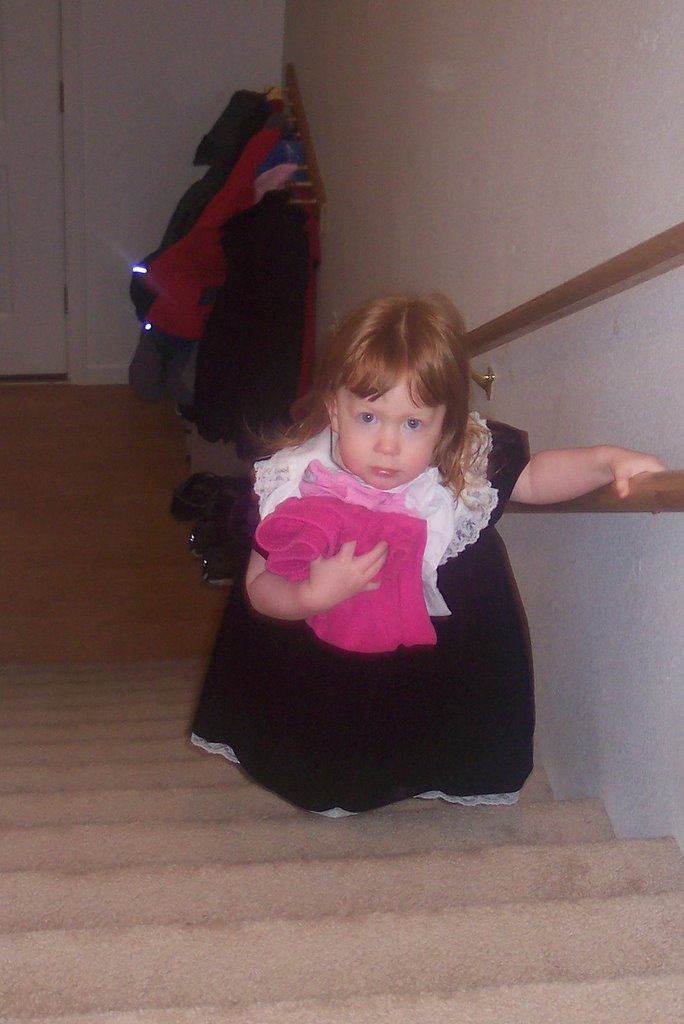 Now it is time to take the folded clothes upstairs. Even 2 y.o. can do this!
(Did you notice our double handrail? We had this put in so little ones have a rail their hands can reach. After all, they are the ones who need a rail to hang onto the most, to get up and down the stairs safely.)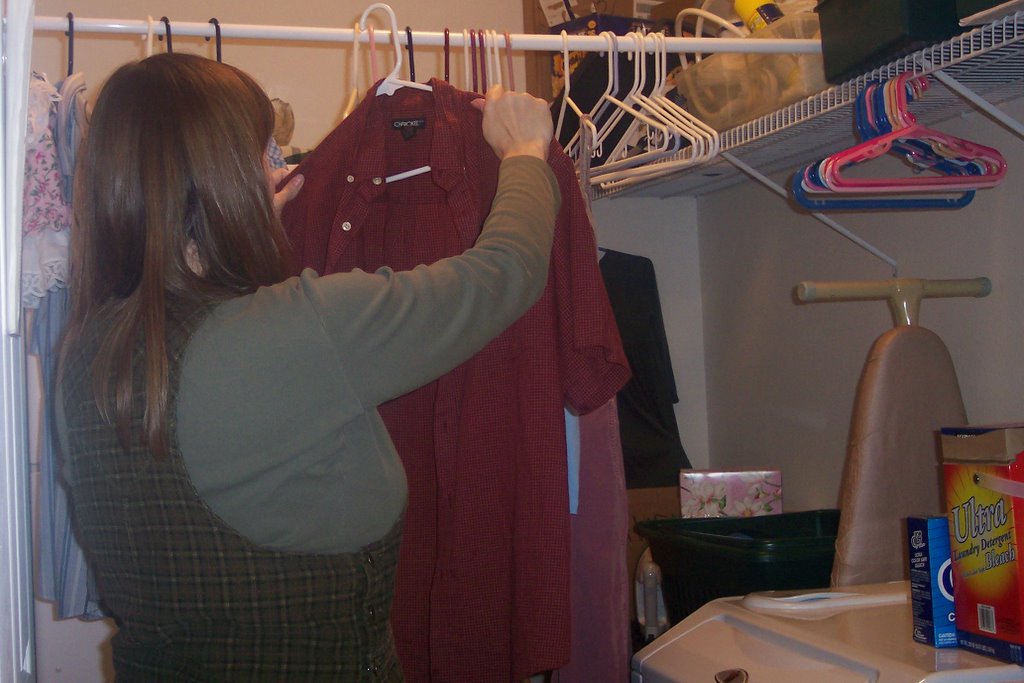 Meanwhile, back in the laundry room.... my two loads have been washing and drying. I try to fold mine right out of the dryer, to avoid wrinkles (I don't have time for ironing). I have work shirts for hubby that are virutally wrinkle free. If something has a kink in it I will use water in a spray bottle and mist the item as I hang it up.
Notice the shower curtain rod I have to hang my clothes up on? There is no room to hang clothes on the wire racking that came stock with our house. A shower curtain rod put across the narrow part of the laundry room works perfectly. It is high enough that the tall people in the house can walk under it. After laundry day there is nothing hanging on it usually. It is also available to "line dry" any items that can't go into the dryer.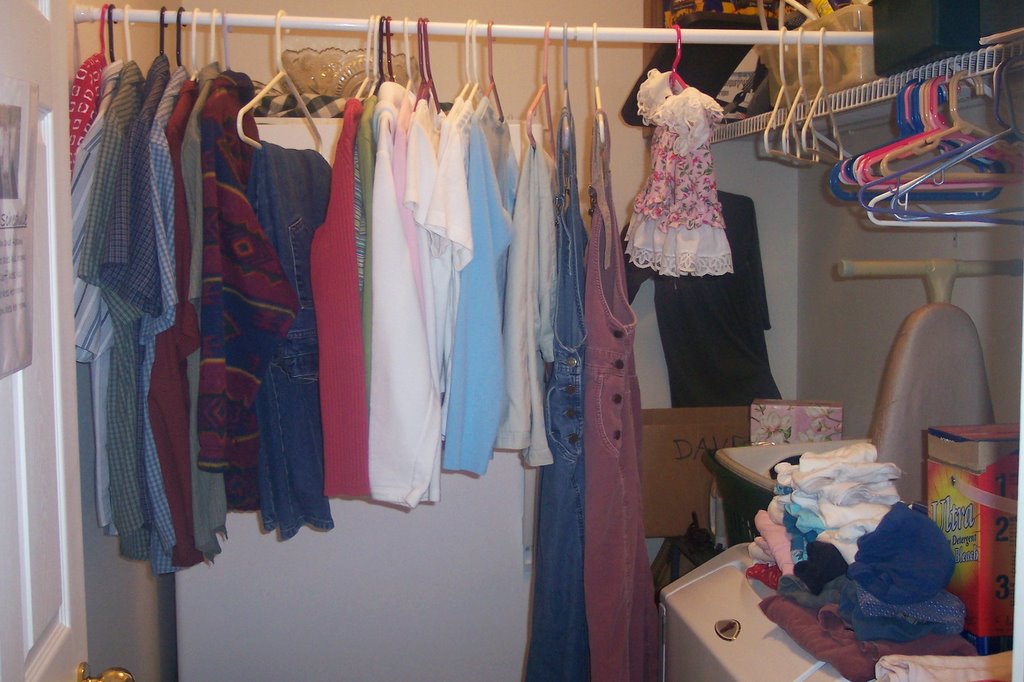 After my loads are hung up and folded (on the top of the washer) I can take them up to my room.
One last thing and that is to fold the socks from my room. I had a total of 24 pairs of socks to match; mine, hubby's and baby's. It took me 3 minutes. No sweat! Because there are only the 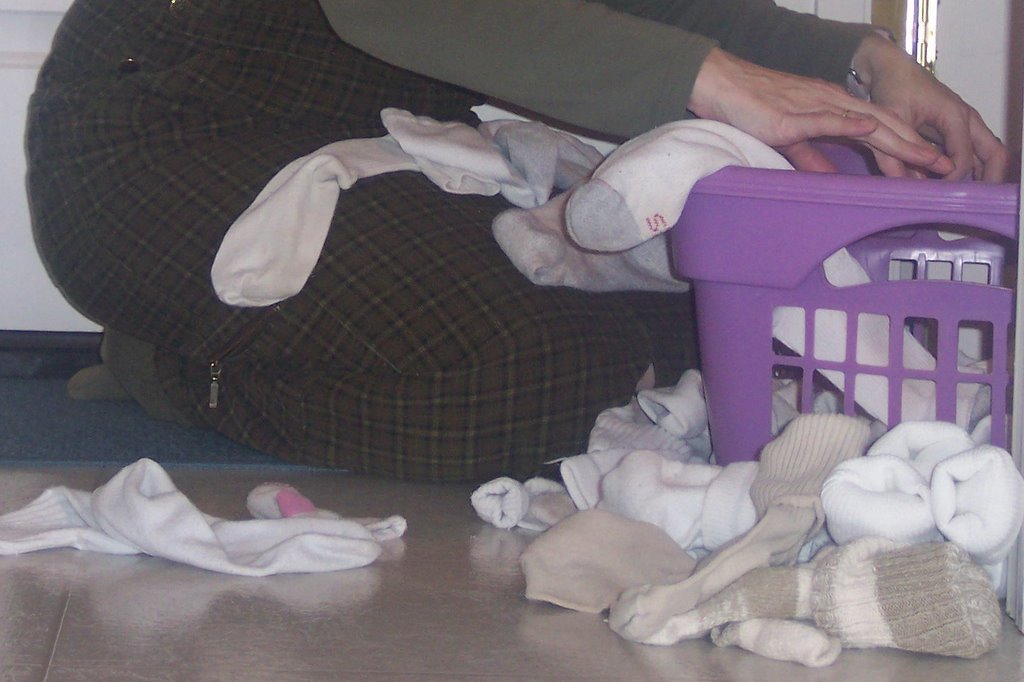 socks belonging to the person doing laundry (or their bedroom buddies) in a load it is easy to match them up and get them back into the right persons drawer.
After I give the children baths before bed this night, I will do a load of towels. I usually get them washed and into the dryer before I go to bed. Sometimes I will get them folded before I go to bed. If not, one of the children will fold them the next day to earn computer time.
February 21, 2006
Laundry - Part One
Roberta asked me to share how I do laundry for my family since I have 12 children. So, this post is about my laundry strategies. What works for you and your family may be different. This post is NOT about how you should wash your clothes, how to fight stains or what the best detergent is, etc.
**Warning! This is going to be LONG, some might even say loquacious!**
My best kept laundry SECRET is:
I DON'T DO THE LAUNDRY FOR ALL 14 OF US!
I am a firm believer of working smarter not harder. I would never have time to blog if I had to do ALL the laundry! (ha!). I also do not pay someone to do our laundry, in case you were wondering. I didn’t start off using this system, back when I had only one child either. That would not have been possible, as you will see. I hope to show you, gentle readers, how having a vision for the future and training your children all along is a investment that pays off well!
BASIC STRATEGY’S
Strategy #1: Clothing Choices
~Girls~
My girls wear mostly dresses with either tights or shorts underneath. For a while I was finding lots of jumper style dresses that needed shirts worn under them when thrift store shopping. These certainly look really cute and a basic jean jumper can be used with several shirts for different looks. The problem is that the amount of shirts and jumpers really adds up per child. Also, more time is needed to match up shirts to go with the jumpers. (I’ll write more about this in Part Two). Because I have five girls (age 8 and under) I have found that one piece dresses are best. My girls really only need approx. 8 regular dresses and maybe 1-2 fancier dresses for special occasions/church. Whether they have fancy dresses really depends on what I find at the thrift store—I don’t buy anything like that new. Because I can’t always find the amount of dresses I need for my girls in the LENGTH that they need (below the knee) at thrift stores I also look at Ebay and will buy dresses when they are on sale or end of season clearance at Land’s End. Five or six pairs of shorts, tights and pj’s , nine pairs of undies, socks and a slip or two complete their wardrobe needs.
~Boys~
Boys are much less complicated in the clothing department! We usually have 2 pairs of jeans and 3 pairs of shorts for the older/teen boys. The younger boys have a combination of jeans and cords (mostly hand-me-downs as this age group does not wear out the knees!) and several pairs of shorts. They all have approx. 8 short sleeve shirts, a few long sleeve shirts and a sweatshirt or hoodie that can be worn over a short sleeve shirt in cold weather. Underwear, socks and 5 sets of pj’s and the boys are set. ~Babies~
All I’m going to say is that I have more baby clothes than I can ever use. I regularly go through my clothes boxes and weed out clothes that have gotten so old the elastic is shot, is too stained, or is just so out of style (my oldest is 20 and some of his baby clothes are still around!) that I wouldn’t use that piece of clothing again. People have been so generous to bless us with hand-me-downs, plus being blessed with new baby clothes when a new baby is born! I don’t pull all we own out for each size as a baby grows. Just enough to get by with. When I can’t close a clothing storage box (we store them by gender and size) because it is over full, it is time to go through and bless someone else with some of our bounty.
Strategy #2: When Do Clothes Go Into The Dirty Clothes Hamper?
OR– “Don’t put your pj’s in the hamper yet, you only wore them one night!”
Yes, it is true. I have come to believe that clothes that are not soiled and do not smell can actually be worn more than once. Teenagers do not qualify for this strategy at all! (They will say it doesn’t have spots or smell, but they are WRONG most of the time) For the pre-adolescent crowd, clothes that meets the no smell, no stain criteria go back in the drawer or closet. This mostly applies to pj’s, shorts and pants. I also have to remember that clothes get dirty faster in the summer than the winter (we don’t go outside much in the winter, living in the northwest).
Strategy #3: A Dirty-Clothes Hamper In Every Bedroom We use two types of hampers. Bedrooms with younger children use a basic Rubbermaid hamper. Older children and hubby and I use the sack type that attach to a plastic tube frame. The older boys get a sack each for their clothes, and I use two sacks to separate whites and darks for mine, hubby and the baby’s clothes. The beauty of having a hamper in each room is that at folding time things like socks are easy to match up because only one bedroom worth of socks is in one load at a time. I will go into this more in Part Two.
Strategy #4: Laundry Day
I set aside one day each week to do laundry. My day is Saturday, because it isn’t a school day and it is a day my husband works every week, so I’m not taking up one of the days he is home working on laundry. Each of the older children who does his own laundry also has their own laundry day. That way we are not fighting over the washer and dryer the same day.
The day I do laundry is flexible. If I know I am going to be doing something on Saturday, I will do laundry on Friday instead. I always move laundry day back a day, not push it farther out if I have to make a change. Also, when life is a bit on the busy side, like now with a newborn, I will start the laundry on Friday night. I will have one load in the washer and one in the dryer when I go to bed Friday night. That gives me a faster start on Saturday and allows for more interruptions to nurse a baby throughout the day. I do two loads of clothes for my hubby, baby and I, and the girls room laundry which is another two loads, plus a load of towels after baths Saturday evening.
Strategy #5: Who Does Laundry?
Remember my secret above, that I don’t do all the laundry? Starting at about age 8-9 I teach the children to do their own laundry, or the laundry for his/her room if he/she shares a room with younger siblings. The child will have watched me do laundry and helped me or an older sibling do it for several years by this point so doing it on their own is no big deal.
On Saturday I wash, dry, fold and put away the clothes for myself, hubby, baby and one load of towels. Also on Saturday my 8 year old daughter washes and dries the clothes for her room (herself and three younger sisters) and I help them fold the clothes. They put their clothes away. My 14 and 11 year old sons (who share a room) take turns every other week washing and drying the laundry for their room and for their younger brothers. Then each person folds his own laundry, except that the 14 year old helps out the 5 year old with folding and is training him to fold on his own. My 17, 18 and 20 year olds are responsible for their own laundry and have been for years.
Strategy #6 - Laundry Is Fun!
I am a firm believer in using the unique window of opportunity that is present in every child from about 1 year of age to 4 years old. Give or take six months depending on the child. They WANT TO HELP MAMA! And daddy too, but we are talking about helping momma right now. When my two year old wants to help put the dirty clothes into the washer (a front loader) I let her. You can be sure she will be right beside me when it is time to transfer them into the dryer and again to put them into the basket. She loves to push the clothes basket to the living room for folding. She will hand me clothes to fold, bring me hangers and can carry her dresses that are on hangers up the stairs for older sister to put in the closet. My four year old also helps in these same ways. She especially likes to pour the detergent in and push the start buttons on the washer and dryer. Can you see how easy it will be for her to do this all on her own in a few more years?
We use this strategy with all household chores by training the young ones while they think it is fun. Then, when they are a little older it is perfectly natural for them to do it on their own. We are careful to start out 3-4 year olds on the family daily chore chart with chores suited to their capabilities.
(Please let me know if you are interested in reading about chores for little people. I could write on that topic next if there is enough interest. You can post a comment below or use the link on the right side of the page to email me directly)